Cripta747, Via Catania 15F, Turin
09.04.2022
654395 years are not enough
Arseny Zhilyaev
Curated by Alessandra Franetovich
About a year ago, we invited the researcher and curator Alessandra Franetovich, together with the artist Arseny Zhilyaev, to think about the concept of an exhibition for March 2022 at Cripta747. On February 24, the context of recent history has crucially turned unstable and violent, which led us to rethink the original project towards its necessary transformation.
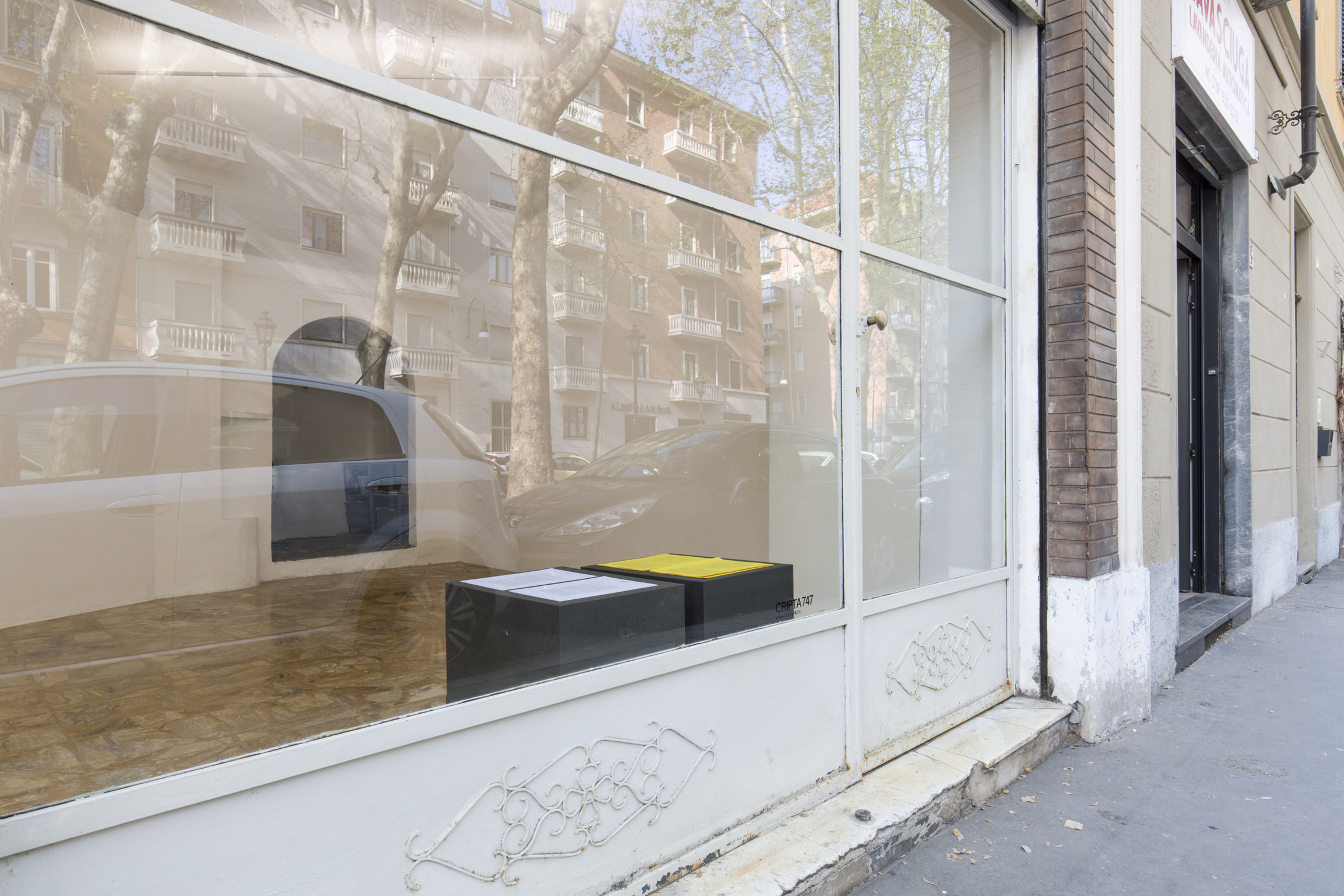
On April 9, from 3 pm until 8 pm, the space of Via Catania 15/F in Turin stayed open, as an invitation to pluralism and dialogue, to welcome all those who wished to take part. The exhibition features contributions by Arseny Zhilyaev and Alessandra Franetovich.
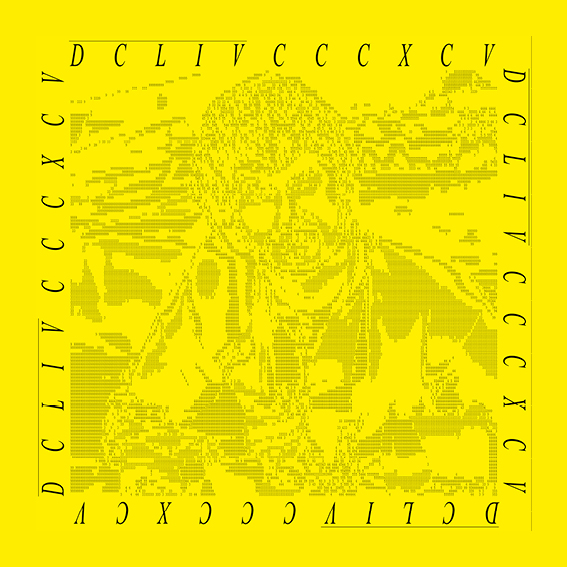
Arseny Zhilyaev. Institute for Mastering of Time
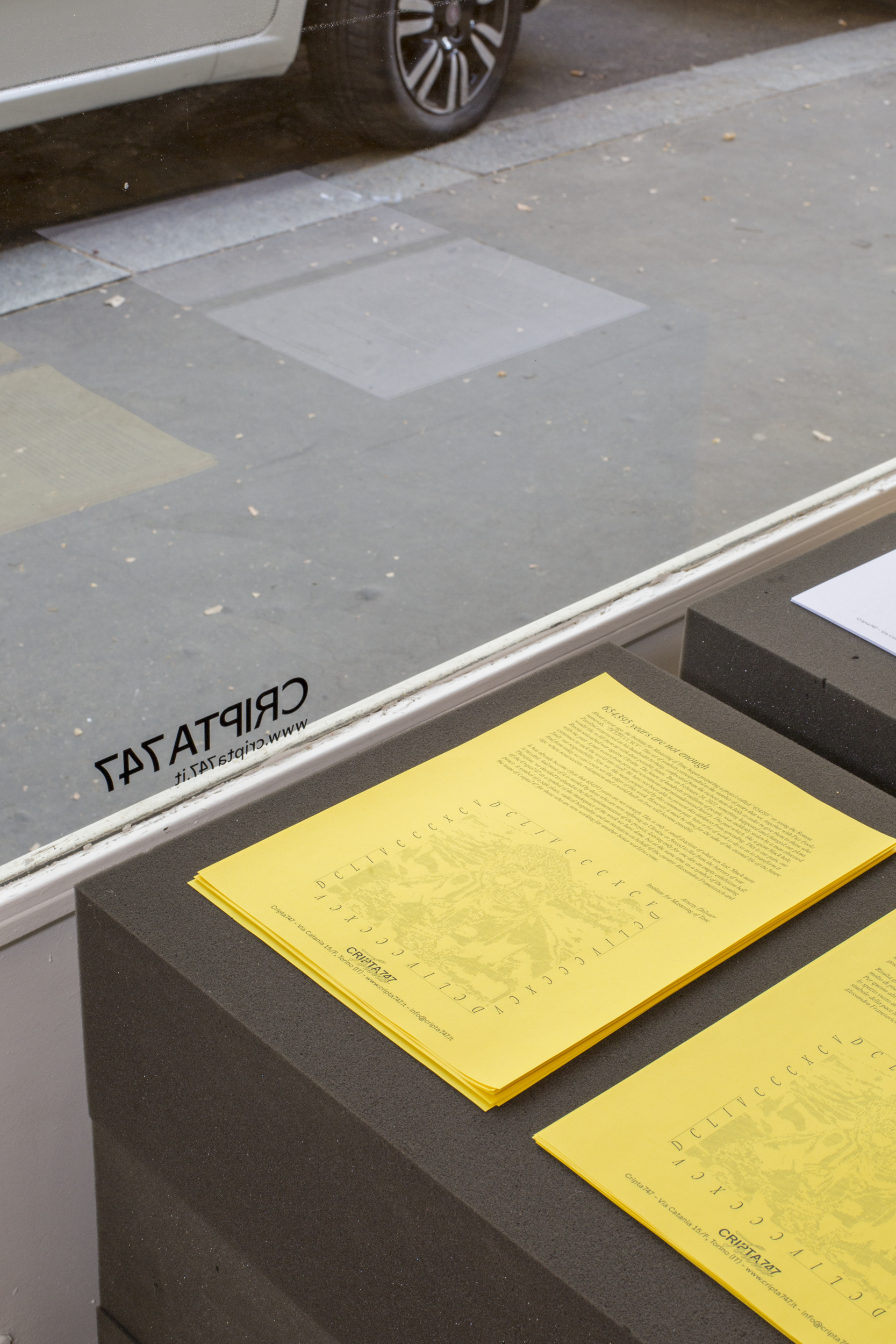
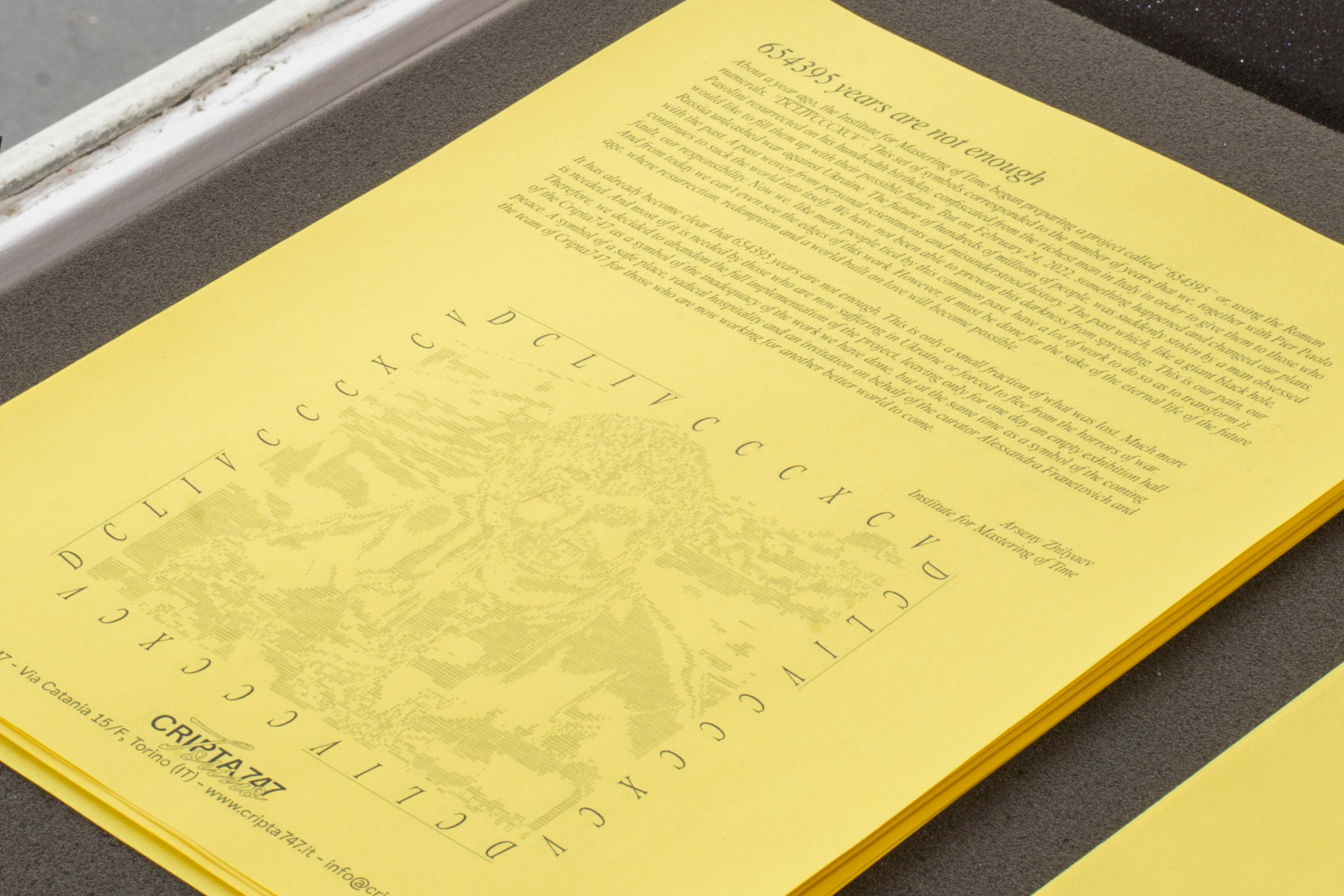
About a year ago, the Institute for Mastering of Time began preparing a project called “654395” or, using the Roman numerals, “DCLIVCCCXCV”. This set of symbols corresponded to the number of years that we, together with Pier Paolo Pasolini resurrected on his hundredth birthday, confiscated from the richest man in Italy in order to give them to those who would like to fill them up with their possible future. But on February 24, 2022, something happened and changed our plans. Russia unleashed war against Ukraine. The future of hundreds of millions of people, was suddenly stolen by a man obsessed with the past. A past woven from personal resentments and misunderstood history. The past which, like a giant black hole, continues to suck the world into itself. We have not been able to prevent this darkness from spreading. This is our pain, our fault, our responsibility. Now we, like many people tied by this common past, have a lot of work to do so as to transform it. And from today we can’t even see the edges of this work. However, it must be done for the sake of the eternal life of the future age, where resurrection, redemption and a world built on love will become possible.
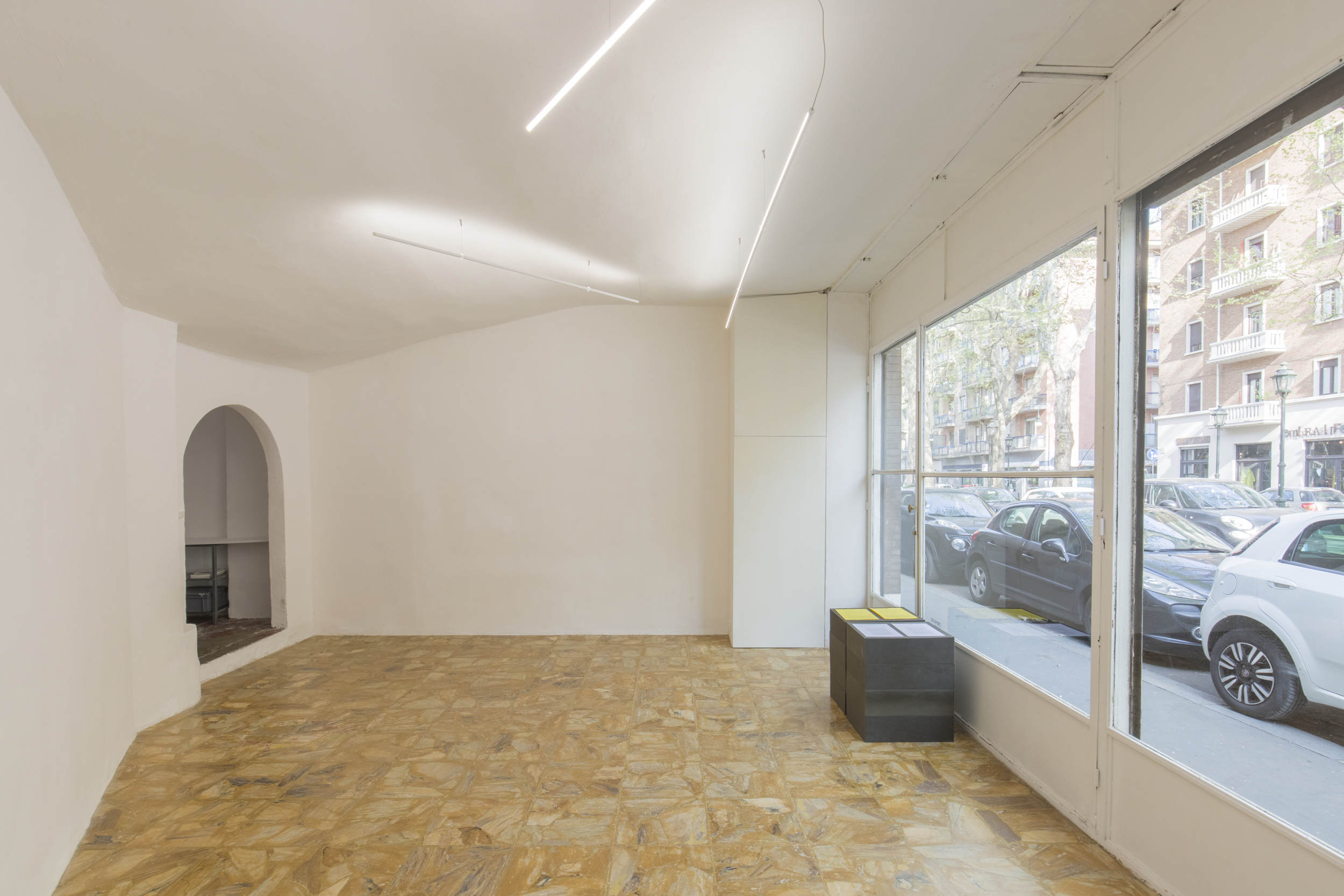
It has already become clear that 654395 years are not enough. This is only a small fraction of what was lost. Much more is needed. And most of it is needed by those who are now suffering in Ukraine or forced to flee from the horrors of war. Therefore, we decided to abandon the full implementation of the project, leaving only for one day an empty exhibition hall of the Cripta747 as a symbol of the inadequacy of the work we have done, but at the same time as a symbol of the coming peace. A symbol of a safe place, radical hospitality and an invitation on behalf of the curator Alessandra Franetovich and the team of Cripta747 for those who are now working for another better world to come.
Alessandra Franetovich
I invited Arseny Zhilyaev to think about a solo exhibition around a year ago, when the possibilities of conceiving and creating art in Italy and in Europe were primarily limited by other contingencies, dictated by the pandemic and the series of consequent restrictions. The idea was to work in spite of this, to regain a space of encounter by relying on the universal role of imagination and art, capable of overcoming all difficulties. His work has always dealt with asperities, with the complicated but necessary relationship of current society with its own history, finding not only a reason to dig into censored and hidden stories to bring them back to light, but also an opportunity to imagine futuristic scenarios. Zhilyaev’s production has a root specifically linked to the utopian history and imagination of the early Soviet era and to the Russian post-Soviet dystopian reality – because of his origin and the issues he addresses – but at the same time it has always been orientated towards a universal, open and inclusive direction, able to involve and include timeless human themes, such as life and death, immortality and resurrection.
This is also the case for the “654395” exhibition project, conceived in the context of the Institute for Mastering of Time, a fictional para-institution conceived by the artist and his colleagues (the first projects were carried out by Zhilyaev together with Asya Volodina; later many people were involved in the institutional activity, including the artists Nika Ham and Nikolay Karabinovych), and whose operation is moved by the creation of trans-historical, trans-national and trans-species futuristic narratives, in which future scenarios are built on speculations originating from the encounter between human imagination and technology, and the dialogue with the machinic element. The speculative use of automation, algorithms, software and machine learning are some of the tools that Zhilyaev uses to create hybrid languages and opportunities to think about the human being in different dimensions, less material, more theoretical, free, fluid. The non-linear conception of time, the overcoming of the limits imposed by political and geographical boundaries, as well as the hybridization between species contribute to build a hypothetical and forerunner vision of what future organisms will be like. A vision which also serves as a mirror through which, today, we can closely observe ourselves as organisms plunged in a defragmentation of the real, distracted by contrasts, difficulties, barbarism, incommunicability and unconsciousness. In this new reality profoundly and radically changed by the war that Russia is waging on Ukraine, Zhilyaev has transformed, in a reductive perspective, what should have been the exhibition “654395”, now become an informal meeting day where the exhibition space also acts as a safe and hospitable place.
In solidarity with the Ukrainian people and with Russians and Belarusians people who are opposing this conflict, as well as with all the victims of wars and oppression, my freedom of action allows me to rethink a future project that needs some time to be more adequately described and presented.
BIO
Arsen Zhilyaev (1984, Voronezh, USSR. Lives and works in Venice) is an artist and organizer of gatherings, exhibitions, quests, and scripts for (future) histories through a variety of conceptual practices. His projects often take the form of (para)fictional institutions and use the museum as their medium. Zhilyaev plays roles in the Institute for Mastering of Time and the Institute of the Cosmos, while tracing the reflections of the Museum of Museums in the Venetian lagoon. His works have been presented at Manifesta in Marseille and at biennials in Shanghai, Gwangju, Liverpool, Lyon, Riga, Thessaloniki, and the Ljubljana Triennale, as well as in exhibitions at the Centre Pompidou and Palais de Tokyo (Paris); de Appel (Amsterdam); HKW (Berlin); Kadist Art Foundation (Paris and San Francisco); GAM (Turin); and MAMbo (Bologna). Zhilyaev graduated from Voronezh State University (2006), the Moscow Institute of Contemporary Art (2008), and the MA International Program at the Valand School of Fine Arts, Gothenburg, Sweden (2010). He is a professor at NABA (Nuova Accademia di Belle Arti) in Milan and has given lectures and masterclasses at MoMA, the Brooklyn Museum, Bard Graduate Center, and CUNY (New York); Tate Modern and Whitechapel Gallery (London); and Princeton University (New Jersey). Zhilyaev is the editor of the anthology Avant-Garde Museology (e-flux, University of Minnesota Press, V-A-C Press, 2015) and publishes articles on e-flux and in Moscow Art Magazine. His works are held in the collections of Tate Modern (London); M HKA (Antwerp); Kadist Art Foundation (Paris, San Francisco); and MSU (Zagreb).
Alessandra Franetovich (1985, Sarzana. Lives and works in Turin) holds a PhD in Contemporary Art History and is a critic and curator. She is currently an affiliated researcher at New York University Abu Dhabi, associate curator at Cripta747, Turin, and lecturer at NABA, Milan. She has conducted research in Berlin and Moscow and has been awarded fellowships by the Garage Museum of Contemporary Art and the V-A-C Foundation. In 2020, she received the Moscow Prize for Young Curators, promoted by the Italian Ministry of Foreign Affairs and International Cooperation and the Ministry of Culture. In 2022, she was awarded the Panorama dell'arte italiana del XXI secolo postdoctoral fellowship by Quadriennale di Roma, as part of which she published the monograph “L'arte italiana e il post 1989. Domeniche alla periferia dell'impero” [Italian Art and the Post-1989: Sundays at the Periphery of the Empire] (postmediabooks, 2025). In 2025, she won the Italian Council grant with an ongoing research project on Arte Povera and the cosmic imaginary. She has published essays and articles in exhibition catalogues and magazines including Studi di Memofonte, Dune, Cosmic Bulletin, and e-flux journal. Her research focuses on unofficial Soviet and post-Soviet art, the post-1989 period, and the influence of futurological theories and space exploration on art.